
What is happening to the Potter Valley Project?
PG&E will decommission the Potter Valley Project on the Eel River and remove Scott and Cape Horn dams. This will bring to an end more than 100 years of diverting water from the Eel River to the Russian River watershed. Originally used to generate electricity for the Ukiah Valley, the diverted water also provided for municipal, irrigation and ecosystem benefits to the Russian River watershed.
Once PG&E removes Cape Horn Dam, the New Eel-Russian Facility will continue to support water supply resiliency in the Russian River watershed by maintaining diversion of water from the Eel River during wet seasons for storage and use during the dry season. Diversions would be undertaken so as not to affect the Eel River’s ecosystem.
Maintaining seasonal diversions of Eel River water to the Russian River and Lake Mendocino would preserve the water supply for hundreds of thousands of people in Mendocino, Sonoma and Marin counties, as well as supporting agricultural uses, wildlife, riparian habitat and sensitive ecosystems along the Russian River.
IWPC Securing Water for the Future May 2025.pdfPG&E's Potter Valley Information Packet, May 2026.pdfLearn more by selecting the drop-downs below:
Potter Valley Project The Potter Valley Hydroelectric Project (PVP) is located on the Eel and Russian rivers in northwestern California. The Eel River Power and Irrigation Company began construction of the PVP in 1905 and completed Cape Horn Dam and Van Arsdale Diversion in 1908. In 1920, the Snow Mountain Water and Power Company began construction of Scott Dam, completed the dam in 1921, and obtained the PVP’s first operational license in 1922. Pacific Gas and Electric Company (PG&E) acquired the PVP and operating license in 1930 and has owned and operated the PVP since its acquisition. Natural flows of Eel River water and water released from Lake Pillsbury storage are diverted 12 miles downstream from Scott Dam at Cape Horn Dam and then are conveyed through a diversion tunnel, conduits, and penstocks to the Potter Valley Powerhouse, which is located in the Russian River watershed. Some of the water discharged from the powerhouse is diverted into canals from which the Potter Valley Irrigation District (PVID) receives water under a water supply agreement with PG&E and its own appropriative water rights license. The remaining water discharged from the powerhouse not consumptively used by PVID flows down the East Fork Russian River into Lake Mendocino. The average annual transfer of Eel River water through PVP between 1922 and 2006 was approximately 150,000 ac-ft. In 2004, the Federal Energy Regulatory Commission (FERC) issued an order amending PG&E’s operating license for the PVP in response to a Biological Opinion issued by the National Marine Fisheries Service (NMFS).
As a result of the license amendment, the average annual transfer of Eel River water through PVP after 2006 declined to approximately 60,000 ac-ft. Since 2021, a transformer bank failure at the PVP powerhouse has resulted in additional reductions in Eel River transfers into the Russian River watershed. This failure caused PVP hydropower generation to cease and, with it, all associated discretionary transfers of Eel River water to the East Branch Russian River. In March 2023, PG&E announced that the transformer would not be replaced, permanently ending hydropower operations. Additionally, new information indicates there is greater seismic risk at Scott Dam than previously understood. Accordingly, PG&E, with concurrence from dam safety engineers at FERC and the Division of Safety of Dams has made the decision to no longer close the spillway gates as a mitigation to reduce seismic risk. This has resulted in the water storage capacity in Lake Pillsbury being reduced by approximately 20,000 ac-ft. PG&E asserts that Lake Pillsbury can no longer sustain normal operations under the current license terms due to the reduced storage capacity. Consequently, PG&E has been submitting flow variance requests annually to FERC requesting modifications to flow requirements under the current operating license. As a result of the transformer failure and the decision to no longer close the spillway gates, Eel River transfers have been further reduced to less than 40,000 ac-ft on average annually. On January 30, 2025, PG&E submitted to FERC a request for a non-capacity license amendment to formalize the changes implemented through the temporary flow variance requests.
On January 25, 2019, PG&E filed a notice of withdrawal of its Notice of Intent to relicense the project and discontinuation of the Integrated Licensing Process. PG&E’s withdrawal from the relicensing process became effective on February 11, 2019. On April 14, 2022, PG&E’s license to operate PVP expired. Since that time, PG&E has operated the project under annual licenses. As a result, local agencies recognizing the urgent need to protect the regional water supply, formed the Eel-Russian Project Authority (ERPA) in 2023 to lead the development of a viable solution for maintaining a continued Eel River diversion into the Russian River watershed following the decommissioning of PVP. ERPA is a joint powers authority comprised of three member agencies: Sonoma Water, Sonoma County, and the Mendocino County Inland Water and Power Commission (IWPC). The IWPC members include: the County of Mendocino, the City of Ukiah, the Redwood Valley County Water District, the Potter Valley Irrigation District and the Mendocino County Russian River Flood Control and Water Conservation District. The Round Valley Indian Tribes have a representative who sits on the ERPA Board.
The primary focus of ERPA is to develop a reconfigured water diversion facility concurrent with PG&E’s removal of Cape Horn Dam (which will occur following FERC issuing a surrender order). The New Eel-Russian Facility (NERF) is designed to divert water from a new facility at the existing Cape Horn Dam site, and will utilize some of the existing PVP infrastructure, including the tunnel now connecting the project to the Russian River. The NERF will allow for continued water diversions from the Eel to the Russian after decommissioning, creating significantly more water supply resiliency in the Russian River watershed than there would be if the PVP was entirely removed. The NERF is anticipated to divert water from the Eel River during fall, winter, and spring for storage and use in the Russian River during the dry season. Diversions would be undertaken in accordance with the terms and conditions of the Water Diversion Agreement for the New Eel Russian Facility (Eel-Russian Project Authority, 2025) that is protective of the Eel River’s ecosystem.
In 2024, ERPA submitted a proposal to PG&E to allow for the construction of the NERF. The plan contemplates that after Cape Horn Dam and a fish barrier are removed, the reservoir (Van Arsdale Reservoir) is drained, resulting in a free-flowing Eel River. The preliminary concept of the New EelRussian Facility is that a mechanical pump station would be constructed simultaneously with the demolition of Cape Horn Dam, utilizing the existing water diversion tunnel, with a reconfigured diversion tunnel entrance.
In July 2025, several entities expressed their support for the NERF and its seasonal diversions of water, by signing the Water Diversion Agreement. The parties to that agreement include California Department of Fish & Wildlife, Round Valley Indian Tribes, Sonoma Water, IWPC, Cal-Trout, Humboldt County, Sonoma County, and Trout Unlimited.
PG&E filed its Final Surrender Application with FERC on July 25, 2025, along with an application for non-project use of project lands. If approved by FERC, non-project use of project lands will authorize PG&E to allow ERPA to construct the NERF within the project boundary. While FERC considers PG&E’s license surrender application and application for non-project use of project lands, ERPA will complete engineering designs and prepare the California Environmental Quality Act (CEQA) requirements for constructing and operating the new facility and work with other state and federal regulatory agencies to secure the permissions necessary to construct the facility. Like FERC’s processing of PG&E’s application, the design and permitting phase of the NERF is expected to last several years.
At this time, because of the significant uncertainty regarding the timing of FERC issuing a surrender order, the schedule for decommissioning of PVP, and the construction of the NERF, Sonoma Water is assuming that PVP will operate under annual licenses issued by FERC with flow conditions modified either by annual flow variance requests or by a non-capacity license amendment until 2035. After 2035, Sonoma Water assumes PG&E will have completed removal of Scott and Cape Horn dams and that ERPA will have completed construction of the NERF and will be operating the facility in accordance with the Water Diversion Agreement.
Video link:
Link to the Eel-Russian Project Authority Webpage.
New Modeling Confirms Water Will Be Available Through Future New Eel-Russian Diversion Facility
Analysis reinforces the region’s path forward with new diversion infrastructure, secured water rights, and expanded storage to protect long term water reliability following PG&E decommissioning of Potter Valley Project
2026, 8-9 IWPC Press Release - Water Supply Modeling Presentation.pdf- YouTube: Understanding the New Eel-Russian Facility: Modeling future water diversions 8/10/26
- Ukiah Daily Journal: Local officials report “stunning” results from water diversion models 8/12/26
- Mendocino Voice: New models say a rebuilt Eel River water link could keep Russian River supplied 8/19/26
Updated February 2025
Two Basin Partnership Memorandum of Agreement (MOU)
FROM THE PRESS DEMOCRAT, FEBRUARY 12, 2025:
Stakeholders on the Eel and Russian rivers have reached agreement on a framework for future water diversions from the Eel into the Russian River, once PG&E decommissions its Potter Valley power plant, through which flows have been directed for nearly 120 years.
A memorandum of understanding to be signed in a ceremony in Sacramento on Thursday [February 13, 2025] allows for limited diversions to continue, but only when the Eel River has sufficiently high flows to accommodate different life stages of federally protected salmon and steelhead trout.
The mostly wintertime diversions will reduce annual transfers into the Russian River watershed from a current level of about 40,000 acre-feet a year to about 35,000 acre-feet. (An acre-foot is equal to 325,851 gallons, or about the amount of water needed to flood most of a football field one foot deep.)
PG&E’s water rights for the diverted flows will be transferred to the Round Valley Indian Tribes, which will collect $1 million a year from Sonoma and Mendocino County users in exchange for diverted flows.
Russian River users also will pay $750,000 to $1 million annually into an Eel River restoration fund to pay for fish recovery and environmental restoration efforts on the Eel River, which has long been impacted negatively by diversions and dams in the river.
The agreement will stand for a 30-year term plus a possible 20-year renewal, but Russian River users are intended to wean themselves from the Eel River by developing new water storage and supply solutions.
Parties to the agreement also agree to endeavor to raise $50 million or more for new diversion facilities and $50 million or more for additional restoration funding.
Signatories include the Sonoma County Water Agency, known as Sonoma Water, the Mendocino County Inland Water and Power Commission, Humboldt County, the Round Valley Indian Tribes, Trout Unlimited, California Trout and the California Department of Fish and Wildlife.
Two Basin Partnership Final signed MOU, February 2025.pdfMCIWPC MOU Press Release 2-11-25.pdfRelated Articles:
- San Fran Chronicle via MSN: Dam removal deal could create longest free-flowing California river, 2/13/25
- Press Democrat: Eel River pact redresses past wrongs, provides model for compromise among diverse interests, officials say, 2/13/25
- Press Democrat: Eel, Russian River deal reached - Historic pact on future waterflows a lifeline for Sonoma, Mendocino, 2/14/25
- CA Department of Fish & Wildlife: Natural Resources Agency Thanks Tribal Leaders, Northern California Counties and Conservation Groups for Their Leadership as Historic Agreement Announced to Secure Water Reliability in the Russian River, Benefit Salmon on the Eel River, 2/13/25
- Trout Unlimited: Breakthrough for the Eel-A new agreement promises to resolve decades of conflict over water use on California’s third largest watershed––and a legendary salmon and steelhead river, 2/13/25
- California Trout Press Release: Regional Partners Sign Historic MOU on Eel River Recovery, 2/13/25
- Eureka Times Standard: ‘The dams will come out’: Humboldt County supervisors sign onto historic Potter Valley water diversion agreement, 2/11/25
- Lost Coast Outpost TODAY in SUPES: Board OKs Agreement on Potter Valley Project Decommissioning and New Eel-Russian Diversion Facility, 2/11/25
- Jefferson Public Radio: Humboldt County Supervisors sign onto historic water agreement for Eel River, 2/12/25
- Redheaded Blackbelt: Humboldt Approves Agreement as End of Potter Valley Project Nears, 2/17/25
- BC 7 KRCR: Multiple agencies sign agreement for Eel River infrastructure, 2/17/25
- Lost Coast Outpost THIS WEEK IN SUPES: Humboldt Supervisors Consider Next Steps for Decommissioning the Potter Valley Project, 2/10/25
- Eureka Times Standard: Eel River diversion agreement on Humboldt County Board of Supervisors agenda, 2-10-25
- Press Democrat: PG&E releases final plan for removal of Scott and Cape Horn dams and elimination of Lake Pillsbury, 2/6/25
- Lost Coast Outpost: Are the Eel River Dams Coming Down? PG&E Releases Final Decommissioning Plan and Will Give a Public Presentation About it, 2/5/25
- Ukiah Daily Journal: PG&E to give update on Potter Valley Project Thursday, 2/4/25
- Ukiah Daily Journal: Update on Potter Valley Project removal, new water-diversion designs, 2/7/25
- Eureka Times Standard: PG&E moves closer to surrender and decommission of Potter Valley Project, 2/ 8/25
- EcoNews Report Podcast by Friends of the Eel: A Deal for the Eel? February 2025\
- E+E Leader: California’s Watershed Agreement Ends Century-Old Water Dispute Over Eel River, 2/18/25
- Redwood News: A Conversation With Friends of the Eel River on the New Potter Valley Project Agreement, 2/19/25
- Press Democrat Editorial: Historic North Coast water deal takes shape, 2/23/25
- Healdsburg Tribune: ‘Historic Pact’ Signed Regarding Healdsburg’s Water Source, 2/23/25
UPDATED OCTOBER 2023:
Regional Partners Submit Proposal to Preserve Potter Valley Diversion and Fish Passage Options
On August 7, 2023, the Mendocino County Inland Water and Power Commission (MCIWPC), the Round Valley Indian Tribes (RVIT), and the Sonoma County Water Agency (Sonoma Water) submitted a proposal to advance a regional solution for preserving flows in the Russian River and improving Eel River fisheries.
On October 3, 2023, PG&E issued a statement on the Proposal for Potter Valley Project’s Draft Surrender Application and Decommissioning Plan :
PG&E has made a non-binding acceptance in concept of the Sonoma County Water Agency, Mendocino County Inland Water and Power Commission and the Round Valley Indian Tribes proposal and agrees to include it in our November 15th 2023 initial draft Surrender Application and Decommissioning Plan (SA). The acceptance of this proposal is non-binding and allows for continued discussion and public comment. The initial Draft SA will be available for public review in November 2023 and will also include PG&E’s proposal to remove Cape Horn Dam. This proposal states that it has co-equal objectives of fish migration and water diversions. PG&E will include both the third-party proposal as well as our decommissioning plan in our initial Draft Surrender Application and Decommissioning Plan.
- Press Democrat: Sonoma, Mendocino county water managers propose pathway for continued Eel River diversions, 8/8/23
- Ukiah Daily Journal: Potter Valley Project: New plan to conserve Eel River diversions submitted to PG&E, 8/8/23
- Times-Standard: Multiple groups wary of new Potter Valley Project plan, 8/10/23
- KZYX: Half-hour special on Potter Valley proposal, 8/16/23
- MendoFever: Mendocino & Sonoma County Water Interests Team-up with Round Valley Tribe to Take Over Potter Valley Project, 8/9/23
- Press Democrat Editorial: No one will win a North Coast water war, 8/13/23
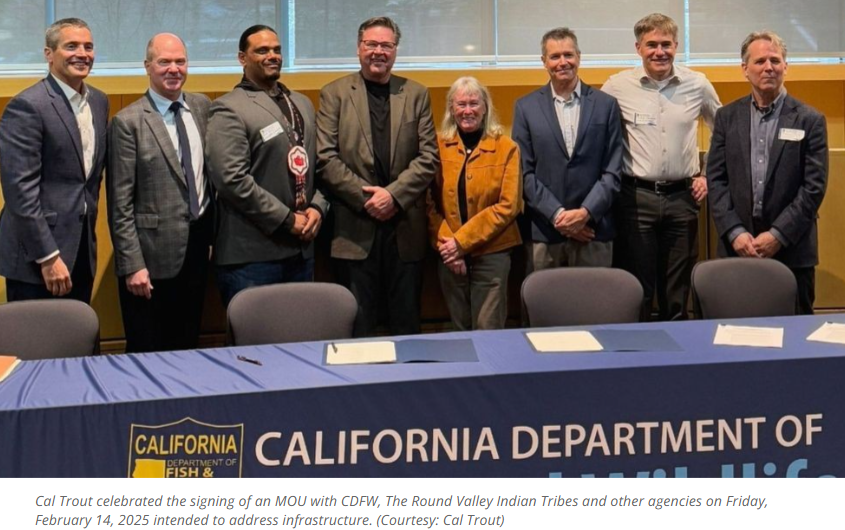
Ceremonial signing of the MOU, February 13, 2025

Trans Basin Diversion (PVP) Related Reports & Studies
Economic Benefits of Removing the Potter Valley Project Dams SUMMARY by BACEI, 2-2-2023.pdfEconomic Benefits of Removing the Potter Valley Project Dams by BACEI, 2-2-2023.pdfEconomic Impacts of Water & Ag Industries inland Mendo Co. by Eyler 2018.pdfEel & Russian River white paper 2024, Gaska.pdfPVP Diversion Faciliy Assess by SCWA 2024.pdf