
Russian River Weekly Update 5/26/26
<Click to view content on website>
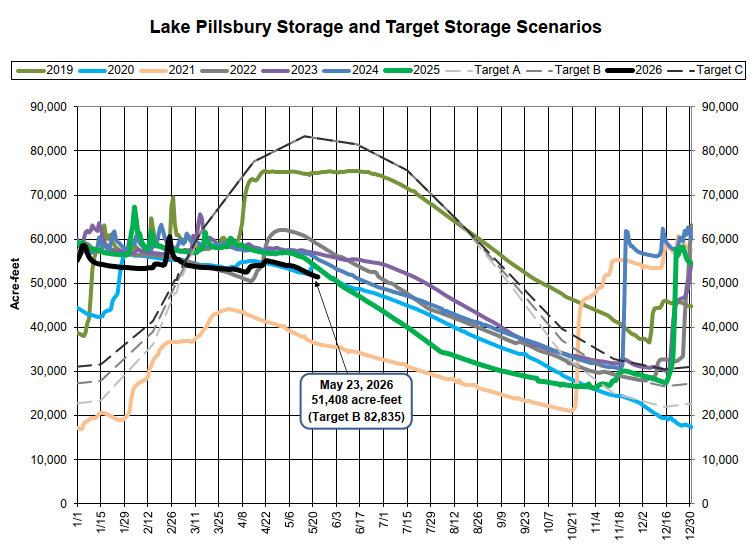
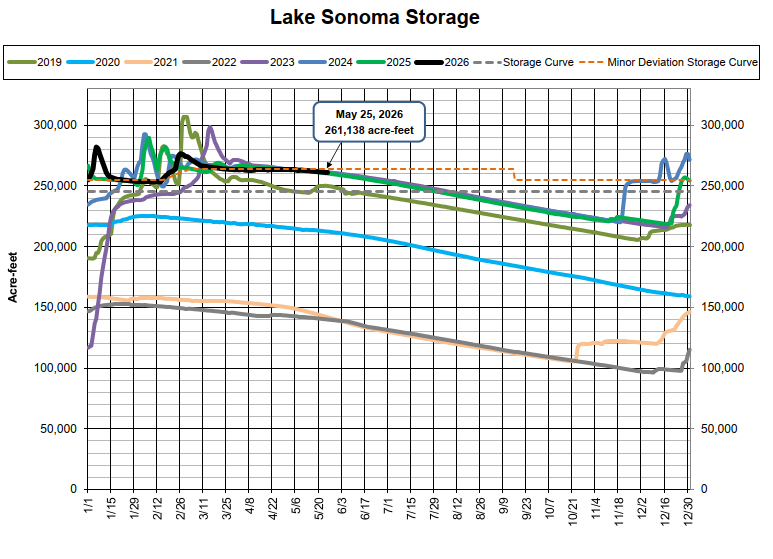
Reservoir Storage & Operations:
Water supply information provided by Sonoma Water (find more water storage info here).


FERC Approves 2026 Potter Valley Project Flow Variance, Effective Friday, May 15th
Reminder, on May 14, 2026, FERC issued an order approving the 2026 temporary flow variance for the Potter Valley Project flows from the Eel to the Russian River. This means that starting May 15th, flows to the Russian River will remain at 25 cfs and will fluctuate between a range of 5-25 cfs based on Lake Pillsbury storage forecasts and water temperature data. Visit the RRFC Webpage for more information.
New Report Recently Released:
2026, 5-14 FERC approval of PG&E 2026 Flow variance.pdf
Future of the Eel River to Russian River Trans Basin Diversion (Potter Valley Project)
RRFC webpage on the Future of the Eel River to Russian River Diversion
PG&E's Potter Valley Information Packet, May 2026.pdfFERC Notice of Scoping Document, Meetings, and Comments
The Federal Energy Regulatory Commission published a Notice of Scoping Meeting and Request for Comments on the Proposed Surrender, Decommissioning, and Non-Project use of Project Lands (NERF) dated May 22, 2026.
FERC will prepare a document discussing the environmental impacts of both the decommissioning and the building of the New Eel Russian Facility (NERF.) FERC will use this document in its decision-making process to identify potential adverse and beneficial impacts of the proposed project surrender and reasonable alternatives. The scoping process gathers input regarding the environmental impacts of the proposal. Specifically, FERC staff request comments on potential alternatives and impacts, as well as identification of any relevant information, studies, or analyses concerning effects on the quality of the human environment.
Comments are due Friday, July 24, 2026. Refer to the documents below for more information.
Two meetings will also be held in Ukiah. Refer to the documents below for more information.
2026, 5-22 FERC PVP NEPA Scoping Notice.pdf2026, 5-22 FERC PVP NEPA Scoping Document.pdf2026, 5-25 IWPC Press Release on FERC scoping doc.pdfRecent comments and articles:
- Press Democrat: 45 Potter Valley posts later, Todd Lands is distancing himself from Southern California agencies eyeing Eel River dams 5/22/26
- Mendocino Voice: The Potter Valley bid that makes no sense 5/25/26
SWRCB Notice of Availability of the Scoping Report for the Potter Valley Hydroelectric Project Surrender and Decommissioning Project
On May 12, 2026, the State Water Resources Control Board (State Water Board or SWRCB) posted the Scoping Report for the Potter Valley Hydroelectric Project Surrender and Decommissioning Project (Scoping Report). The Scoping Report summarizes comments received during the State Water Board’s Notice of Preparation of an Environmental Impact Report for the Potter Valley Hydroelectric Project Surrender and Decommissioning Project public comment period, which closed on November 3, 2025.
Link to the Scoping Report on Maven's Notebook website
Additional information related to the Potter Valley Hydroelectric Project can be found on the State Water Board’s Potter Valley Hydroelectric Project webpage: SWRCB Potter Valley Hydroelectric Project webpage
Questions regarding the Scoping Report or Potter Valley Hydroelectric Project: please contact Wilhelmina Chon, Project Manager by email at: Wilhelmina.Chon@waterboards.ca.gov.
WEBINAR: Tribal Water Rights in California, June 4th, 11 AM - Noon
Water rights are essential to the well-being of California’s Tribes—yet these rights are often poorly understood. As Tribes begin to play an increasingly significant role in regional water management in California, we present key findings from a new report about the history and current status of Tribal water rights and convene a panel of experts to discuss what’s next. More information and registration.
- PPIC: Tribal Water Rights in California May 2026
- PPIC: Tribal Water Rights and Water Use in California May 2026
Asian American Pacific Islander Heritage Month May 29th, noon - 1 PM
California Natural Resources Agency Celebrates Asian American Pacific Islander Heritage Month Connecting with AAPI Trailblazers Advancing Climate Action and Equity in California. As national rhetoric targets immigrants, weakens voting access, questions birthright citizenship, and cuts support for Asian American and Pacific Islander (AAPI) communities, California stands for a different future by defending inclusion, opportunity, and respect for all. This AAPI Heritage Month, join Secretary Wade Crowfoot for a conversation honoring AAPI leaders advancing climate action, expanding access to nature, and helping build a stronger, more inclusive California for future generations. Registration
DWR Releases Spring 2026 Semi-Annual Groundwater Update
The Department of Water Resources (DWR) has released the Spring 2026 Semi-Annual Groundwater Update, which provides a look back at California’s groundwater conditions during Water Year 2025 and early Water Year 2026. The groundwater update includes Water Year 2025 Groundwater Sustainability Plans (GSP) and GSP Alternative annual report data reported across 101 groundwater basins, which make up over 90 percent of the groundwater use in the state. This information is helping provide an increasingly clearer picture of groundwater conditions, including the amount of change in groundwater storage, groundwater extractions, and managed recharge that occurs each year. More information
WEBINAR: Unveiling CA’s New Climate Change Projections to Guide Action May 26, 1-5 PM
This hybrid event will kick off the rollout of California's Fifth Climate Change Assessment, with a presentation of updated data and projections on climate, sea level rise, water systems, and wildfire risk across the state.
These projections provide the foundation for the Assessment’s research and will help guide policy and investment decisions to protect communities and strengthen climate resilience across the state.
Background: To advance action-based science around climate change, in 2006, California developed the state's Climate Change Assessment, a collection of research and data that provides the tools and information to help leaders and communities across California plan for and respond to climate impacts. The Assessment is updated at least every five years. Previous Assessments (2006, 2009, 2012, 2018) contributed to a growing understanding about the impacts of climate change in California and offer communities and decision-makers the tools to take action.
Over the past five years, the California Natural Resources Agency (CNRA), in partnership with the Governor’s Office of Land Use and Climate Innovation (LCI), the California Energy Commission (CEC), and the California Strategic Growth Council (SGC), has worked with academic, tribal, and community partners to develop the Fifth Climate Change Assessment. It will support on-the-ground implementation and decision-making at the local, regional, tribal, and state levels, focusing on the needs of communities most vulnerable to climate change impacts.
Fifth Assessment reports will begin to roll out this summer with many opportunities to participate in events and activities to learn from experts. Throughout the rollout, we will share upcoming Assessment events, featured stories and voices of the Assessment's research, and provide information in the lead up to the full release in late 2026. For any questions regarding the Fifth Assessment, please reach out to climateassessment@lci.ca.gov.
WEBINAR: Co-Creating the Water Future We Deserve, May 27 12:00 1:30 PM
California's water future isn't fixed. It's being written right now – through policy choices, infrastructure decisions, and allocation tradeoffs that will shape landscapes and communities for generations. The question is: who gets to help write it? COEQWAL, the Collaboratory for Equity in Water Allocations, was built on the premise that the answer should be all of us. A partnership among UC Berkeley researchers, state agencies, and community groups, COEQWAL uses CalSim3, California's primary water planning model, to envision and evaluate alternative water futures under a range of climate, policy, and infrastructure scenarios. Those futures aren't just handed down from a modeling team; they're co-created with the people who will live them. Results are shared through a public data platform where anyone can explore, filter, and interact with scenario outcomes through data visualizations and storytelling tools designed to reach and engage diverse audiences. Join us for a Data for Lunch with UC Berkeley's Ted Grantham, who leads COEQWAL, as he shares what it looks like to bring communities, researchers, and decision-makers together around a shared vision for California's water future. And what's possible when they do. Register Now
WEBINAR: “Voices from the Field” May 27 11AM
This month, Sustainable Conservation continues with its successful webinar series “Voices from the Field.” The next webinar, the third in this series, is scheduled for Wednesday, May 27, at 11 a.m. “From Field to Policy: Scaling Sustainable Agriculture,” will feature panelists from General Mills, East Turlock Subbasin Groundwater Sustainability Agency, and EcoThrive Farm Management. Together, they’ll explore how farmer engagement, science, and policy can work together to advance and expand sustainable agriculture across California. The conversation will examine how growers, researchers, water managers, and industry partners are finding common ground to support soil health and groundwater sustainability under the Sustainable Groundwater Management Act. Registration is required for this hour-long webinar.
In the press:
- DWR Weekly Water Highlights — May 20, 2026
- Maven's Notebook Weekly May 17-22
- Maven's Notebook Weekend Edition 5/22/26
- SWRCB Ebb and Flow Blog, 5/20/26
- Weather West: Another late-spring cut-off to bring mountain showers, coastal drizzle, and cooler temperatures before likely June warm-up 5/25/26
- CalMatters Commentary: California’s best chance for enough water in the future is to bolster local supplies today 5/19/26
- SF Gate: Sonoma Co: Russian River Dam Raised To Shore Up Drinking Water Supply 5/18/26
- Press Democrat: Sonoma Water awarded nearly $48 million to upgrade troubled lower Russian River wastewater system 5/19/26
- DWR: Data Transparency is Key to California Achieving Groundwater Sustainability 5/19/26
- Local News Matters: Sonoma Water raises Russian River dam to shore up summer drinking water supply 5/19/26
- SF Gate: Sonoma Co.: Who Owns The Beaches On The Russian River? 5/20/26
- DWR Launching Assistance Programs for Proposition 4 Funding 5/22/26
- LA Times: Southern California could get 85% of its water locally and avoid Delta tunnel, groups say 5/25/26